
Save SNAP-Ed

Exploring ways to preserve SNAP-Ed

#SAVESNAPED #SNAPEDWORKS

Video Resources

SNAP-Ed saves money and stretches dollars.

Congress is considering a bill that would eliminate SNAP-Ed—a critical program that helps low-income families make healthier food choices and lead more active lives.

SNAP-Ed is a proven, cost-effective program that empowers people who receive SNAP to improve their health, stretch their food dollars, and become self-reliant.

Take action using the Save SNAP-Ed Advocacy Toolkit or by sharing the resources below with your network!

Read the rebuttal to the Statement that SNAP-Ed is duplicative.

Fourth Grade Student
"During our fruits and vegetables lesson, we had a food-tasting activity. One of the vegetables I passed out was carrots. As I was passing them out, one student told me he had never

Nebraska SNAP-Ed Staff

"During the pilot launch of Double Up Food Bucks (DUFB) in Lincoln, NE in 2017, I was able to support the program as a student employee. At the time, I was an undergraduate

Nebraska Mom of Two

"Through the Grow Together Nebraska program, a donation garden made possible by SNAP-Ed funding, a colleague and I partner with our Master Gardeners to grow, tend, harvest, and donate fresh produce to local

Rural Nutrition Education

"My name is Otis, and I work for Maine Snap-Ed in a rural county called Aroostook County or the 'Crown' of Maine. I was born and raised in this area, so teaching here

Maine Farmer

"As a nutrition educator I have had the opportunity to watch children cheer for vegetables they have never had the opportunity to try before, older adults try yoghurt for the first time and

School Teacher in Maine

"I work for a school where the majority of the students come from low income families. These families have limited budgets and, to be blunt, little education on health foods. These kids lack

Maine Nutrition Educator

"I've worked for SNAP-Ed for the past 18 years and have seen and heard from participants the positive impact its made on their lives. My job involves everything from introducing young children to

School Teacher

"I am a school teacher and my students and I have been very fortunate to work with Ginger. She is amazing. She does classes to help out children learn about eating well."

Kansas SNAP-Ed Participant

"This program has given me the most crucial tool anyone can have and that is more information. More information on how to shop, how to prep my food, and how to eat. This

SNAP-Ed Participant

"A neighbor participated in the Nutrition Facts Label lesson and learned what the nutrition facts label was and how to use it. After the lesson, the neighbor felt empowered to get healthier, stating     'Learning

SNAP-Ed Participant

"One of the neighbors shared that she wanted to start losing weight and drinking more water.  I suggested that she join a group and start walking 3-5 miles a day and maybe add

Nelson, SNAP-Ed Participant

"Nelson is always eager to hear the lessons I offer at the food distribution. He listens throughout my time sharing, asks questions afterwards, and contributes throughout by sharing what types of vegetables he's
1 8 9 10 11 12 17

Research Articles

LT17: Health Care Cost Savings

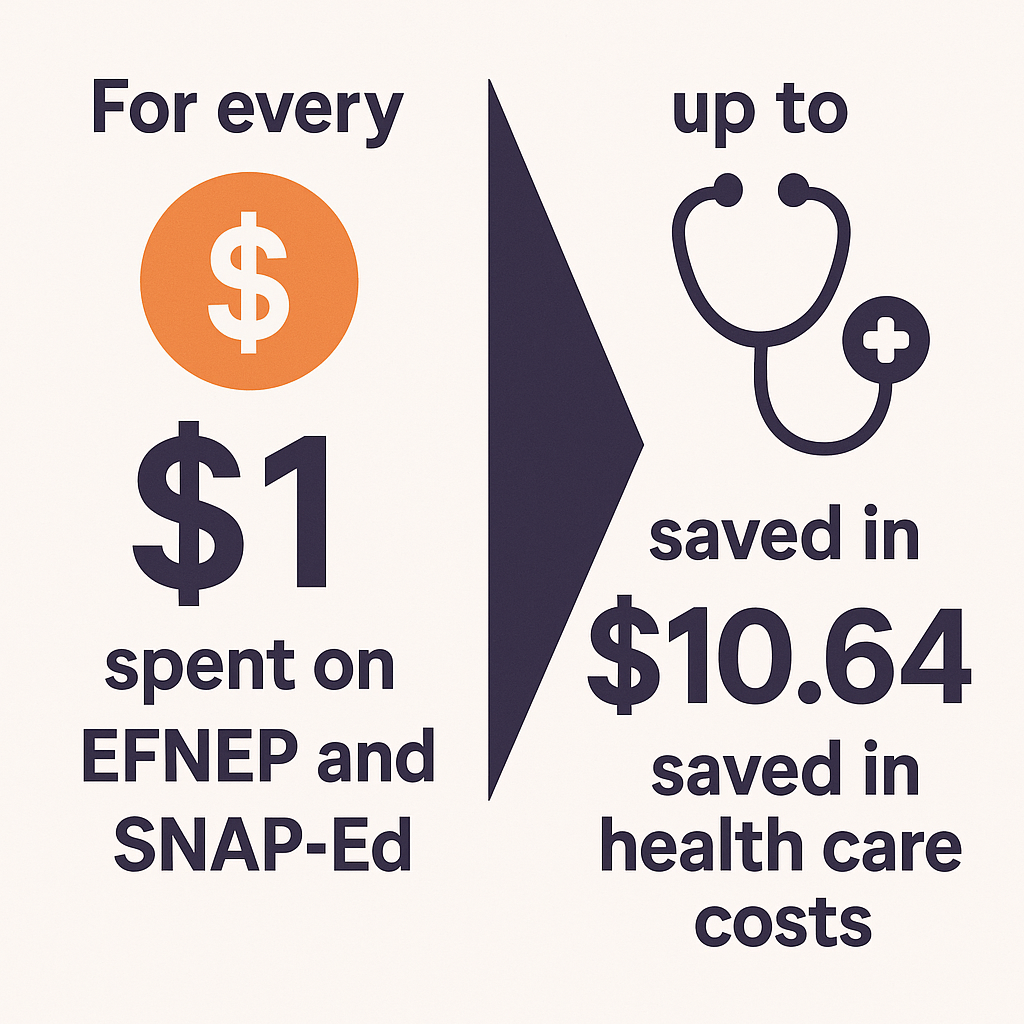
“Existing studies show that for every $1 spent to implement programs such as EFNEP and SNAP-Ed education programs, up to $10.64 is saved in health care costs.5 These studies pre-date the provisions of HHFKA and SNAP-Ed's expanded reach through comprehensive scope of services, thus we anticipate potential health care costs savings to be even greater.”
SNAP-Ed (Supplemental Nutrition Assistance Program-Education) Increases Long-Term Food Security among Indiana Households with Children in a Randomized Controlled Study

Rivera, R. L., Maulding, M. K., Abbott, A. R., Craig, B. A., & Eicher-Miller, H. A. (2016). SNAP-Ed (Supplemental Nutrition Assistance Program-Education) Increases Long-Term Food Security among Indiana Households with Children in a Randomized Controlled Study. The Journal of nutrition, 146(11), 2375–2382. https://doi.org/10.3945/jn.116.231373
The SNAP-Ed Evaluation Framework: demonstrating the impact of a national framework for obesity prevention in low-income populations

This article introduces and describes the benefits of the newly developed SNAP-Ed Evaluation Framework (Framework) and companion Interpretive Guide to consistently measure SNAP-Ed outcomes across different settings
Effect of Supplemental Nutrition Assistance Program–Education (SNAP-Ed) on food security and dietary outcomes

This narrative review summarizes current investigations of SNAP-Ed’s effectiveness at improving food security and dietary outcomes, and it can help inform future policy and implementation of the program.
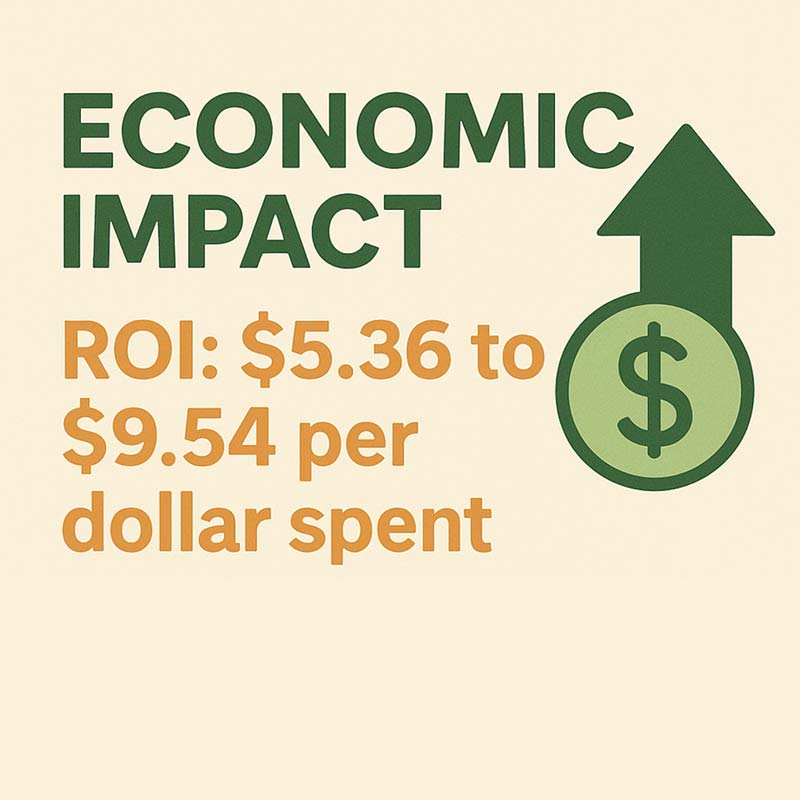
Cost-benefit analysis conducted for nutrition education in California:

A cost-benefit analysis was conducted using the program demographics and food-related dietary behavior of participants enrolled in California’s Expanded Food and Nutrition Education Program (EFNEP), based on methodology developed by Virginia Cooperative Extension.
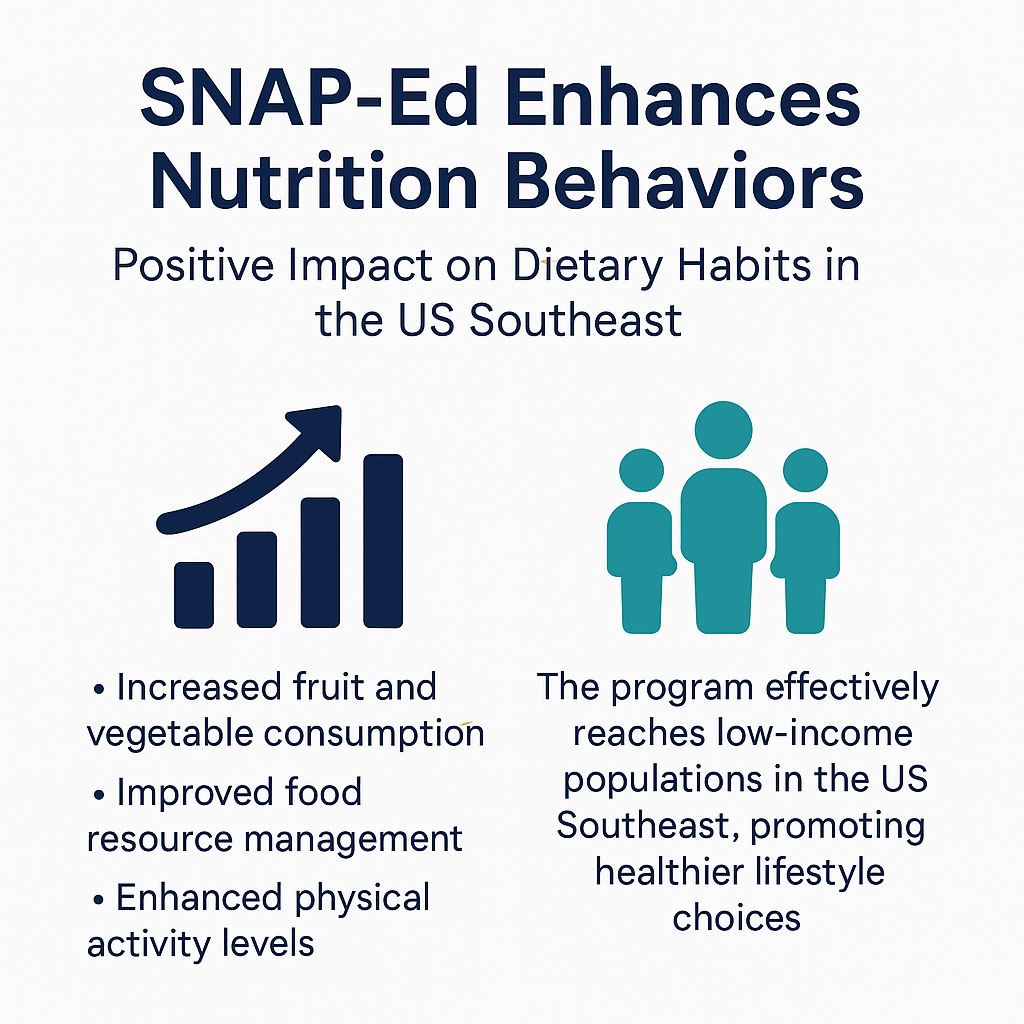
The US Supplemental Nutrition Assistance Program – Education improves nutrition-related behaviors

This study suggests that SNAP-Ed direct education is associated with positive behaviour changes in the US Southeast.
Supplemental Nutrition Assistance Program Education reductions during COVID-19 may have exacerbated health inequities

Woodward-Lopez, G., Esaryk, E. E., Hewawitharana, S. C., Kao, J., Talmage, E., & Rider, C. D. (2023).

Making Headlines

“[SNAP] is really MAHA for low-income people,” Jerry Mande, adjunct professor of nutrition at Harvard T.H. Chan School of Public Health, told your host. “Not just SNAP recipients, but all low-income people.”
The Supplemental Nutrition Assistance Program Education, or SNAP-Ed, faces elimination in a GOP bill, sparking concerns about the impact on low-income Americans' health education.
"The cost of this program is roughly half a billion dollars a year, not even a rounding error in the federal budget. Cutting it does no good for anyone, undercuts the MAHA (Make America Healthy Again) agenda, and is thoughtless and unnecessary."
“It does, in fact, enact deep cuts to Medicaid and SNAP that will result in eligible people losing those benefits. It will raise grocery prices and health care costs for tens of thousands of West Virginia families,”
“The loss of SNAP-Ed funding may further hinder public health efforts, reducing resources for obesity prevention and nutrition education in immigrant communities. States may face pressure to cover these gaps, but fiscal constraints could limit such efforts, disproportionately harming low-income and immigrant populations.”
An initial analysis by the Wisconsin DHS showed that a set of proposals in the new bill to cut funding for the SNAP program would take food away from families, shift costs to Wisconsin taxpayers, and increase red-tape requirements, making it harder for parents, kids, people with disabilities, and older adults to get food assistance.

Take Action Today!​