
Save SNAP-Ed

Exploring ways to preserve SNAP-Ed

#SAVESNAPED #SNAPEDWORKS

Video Resources

SNAP-Ed saves money and stretches dollars.

Congress is considering a bill that would eliminate SNAP-Ed—a critical program that helps low-income families make healthier food choices and lead more active lives.

SNAP-Ed is a proven, cost-effective program that empowers people who receive SNAP to improve their health, stretch their food dollars, and become self-reliant.

Take action using the Save SNAP-Ed Advocacy Toolkit or by sharing the resources below with your network!

Read the rebuttal to the Statement that SNAP-Ed is duplicative.

Alabama Boys and Girls Club

"I work directly with a SNAP-Ed employee and had the pleasure of observing her presentation to a boys and girls club group of kids. The activity included the making of a smoothie as

PreK Students Explore Cabbage

"Our Claysburg PreK Counts classroom recently participated in a Healthy Kids Club lesson where the children got hands-on with cabbage! They explored its texture, smell, and taste, wrapping up the experience with a

Head Start Partnership

"Partnering for Healthy Futures: We're proud to highlight the partnership between Blair County Head Start and the Center for Childhood Obesity Research (CCOR) at Penn State. Through CCOR's Healthy Kids Club, funded by

Pennsylvania Teacher

"A teacher who is a self-proclaimed “picky eater” would take a small bite of each tasting that was provided in her classroom. She ended up asking me to send her the recipes because

Philadelphia Public Charter School

"Independence Charter School, a public charter school in center city Philadelphia, serves 800 students (approximately 600 families) and we have had the immense benefit of having SNAP-ED as an integral part of our

SNAP-Ed Partner

"I believe SNAP-Ed is a wonderful resource in our community. The Cornell Cooperative Extension has been a fantastic partner and a joy to work with. In doing so, we have had the opportunity

Second Grade Teacher

"I am a teacher and teach 2nd grade. I’ve had the pleasure of having this program in my classroom for the last 2 years and it has shown great benefit for my students.

Philadelphia Community Member

"It’s rare to see people so engaged with our community and wanting to make our community better through agriculture, we need this in our small communities, where the price of fresh produce is

Nutrition and Garden Participant

"SNAP Ed benefits me as someone dealing with mental health issues and being a resident at one of the sites where SNAP Ed provides nutrition and community garden work. The garden helps with

Florida Teacher

"I am a teacher at a school that received SNAP—ED services. A nutrition and gardening expert came to our school weekly to teach my second graders about nutrition and supported us in starting

An Ohio Recovery Council Group

"Each year, the Ross County OSU Extension Office offers a Cooking Matters series for women who are part of the Recovery Council group. The FCS Educator and SNAP-Ed Program Assistants work together to

Independent Housing Manager

"I work in a HUD independent housing facility for the elderly and disabled. We have had the SNAP-Ed staff come and provide nutrition and exercise classes. This has been so helpful as it

Research Articles

LT17: Health Care Cost Savings

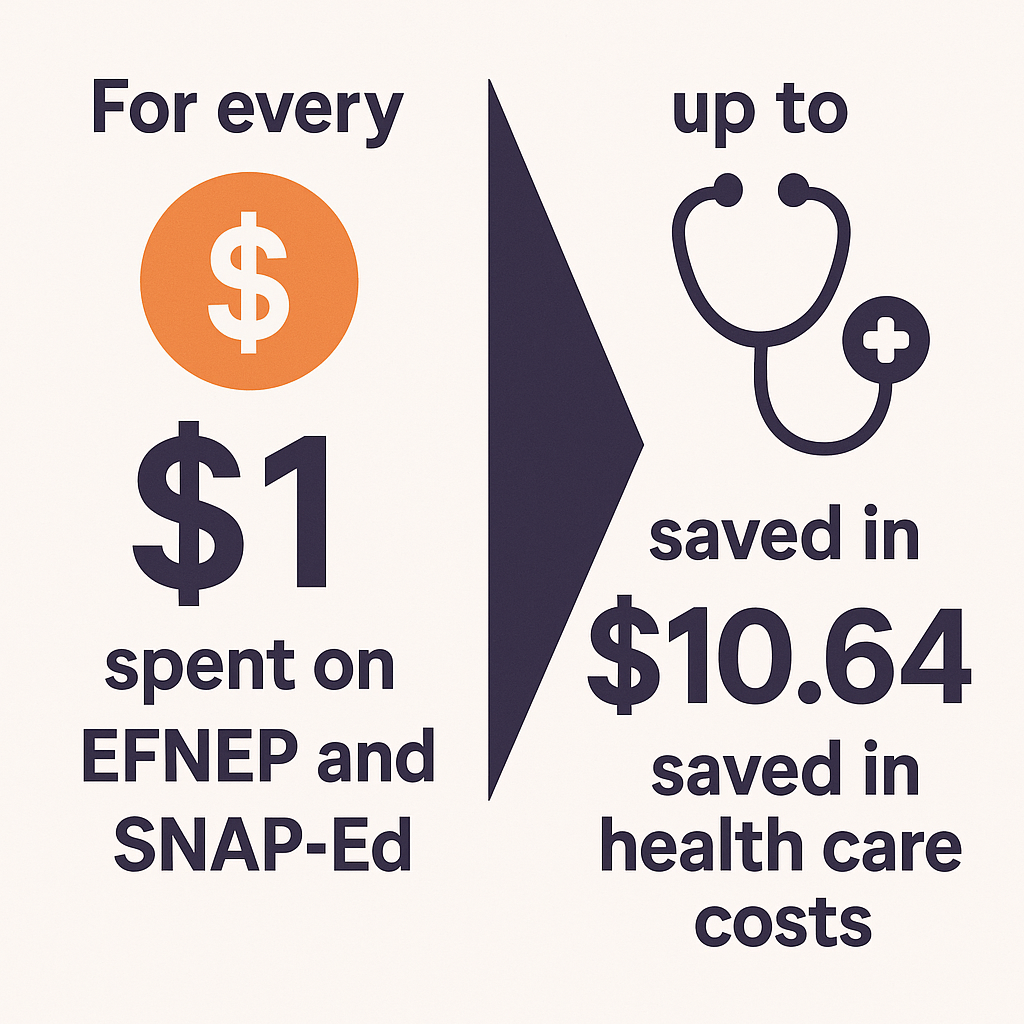
“Existing studies show that for every $1 spent to implement programs such as EFNEP and SNAP-Ed education programs, up to $10.64 is saved in health care costs.5 These studies pre-date the provisions of HHFKA and SNAP-Ed's expanded reach through comprehensive scope of services, thus we anticipate potential health care costs savings to be even greater.”
SNAP-Ed (Supplemental Nutrition Assistance Program-Education) Increases Long-Term Food Security among Indiana Households with Children in a Randomized Controlled Study

Rivera, R. L., Maulding, M. K., Abbott, A. R., Craig, B. A., & Eicher-Miller, H. A. (2016). SNAP-Ed (Supplemental Nutrition Assistance Program-Education) Increases Long-Term Food Security among Indiana Households with Children in a Randomized Controlled Study. The Journal of nutrition, 146(11), 2375–2382. https://doi.org/10.3945/jn.116.231373
The SNAP-Ed Evaluation Framework: demonstrating the impact of a national framework for obesity prevention in low-income populations

This article introduces and describes the benefits of the newly developed SNAP-Ed Evaluation Framework (Framework) and companion Interpretive Guide to consistently measure SNAP-Ed outcomes across different settings
Effect of Supplemental Nutrition Assistance Program–Education (SNAP-Ed) on food security and dietary outcomes

This narrative review summarizes current investigations of SNAP-Ed’s effectiveness at improving food security and dietary outcomes, and it can help inform future policy and implementation of the program.
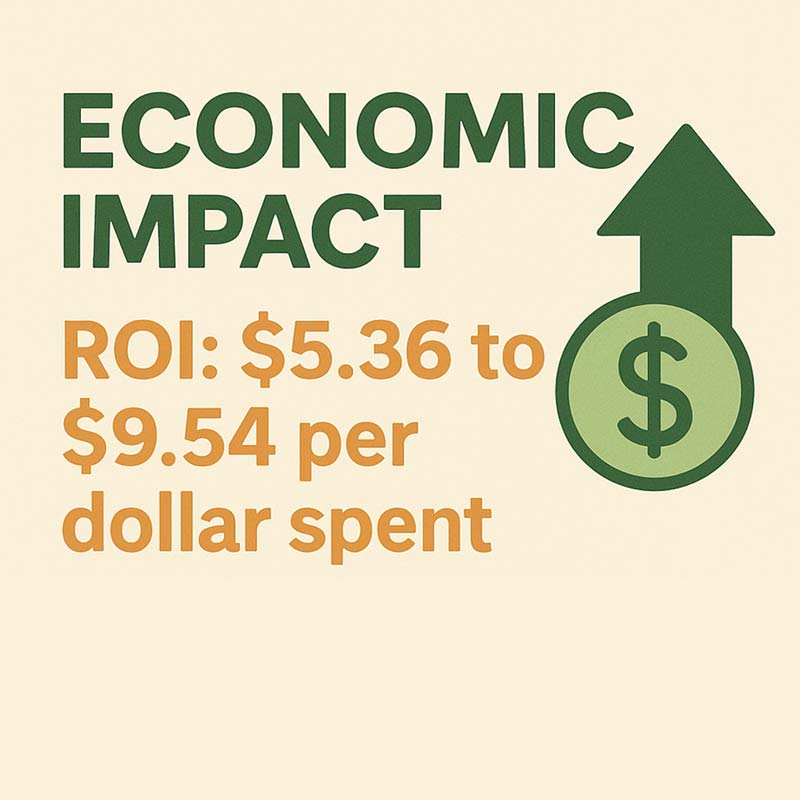
Cost-benefit analysis conducted for nutrition education in California:

A cost-benefit analysis was conducted using the program demographics and food-related dietary behavior of participants enrolled in California’s Expanded Food and Nutrition Education Program (EFNEP), based on methodology developed by Virginia Cooperative Extension.
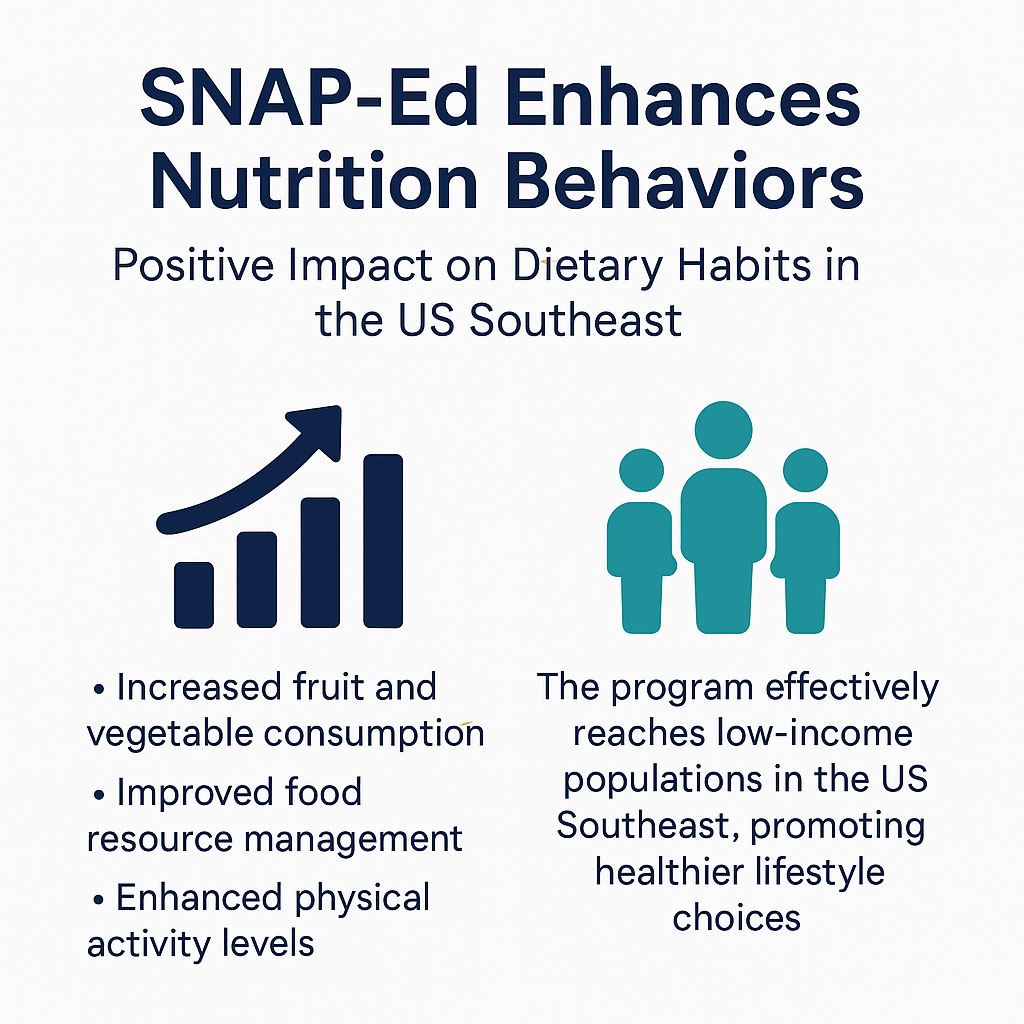
The US Supplemental Nutrition Assistance Program – Education improves nutrition-related behaviors

This study suggests that SNAP-Ed direct education is associated with positive behaviour changes in the US Southeast.
Supplemental Nutrition Assistance Program Education reductions during COVID-19 may have exacerbated health inequities

Woodward-Lopez, G., Esaryk, E. E., Hewawitharana, S. C., Kao, J., Talmage, E., & Rider, C. D. (2023).

Making Headlines

“[SNAP] is really MAHA for low-income people,” Jerry Mande, adjunct professor of nutrition at Harvard T.H. Chan School of Public Health, told your host. “Not just SNAP recipients, but all low-income people.”
The Supplemental Nutrition Assistance Program Education, or SNAP-Ed, faces elimination in a GOP bill, sparking concerns about the impact on low-income Americans' health education.
"The cost of this program is roughly half a billion dollars a year, not even a rounding error in the federal budget. Cutting it does no good for anyone, undercuts the MAHA (Make America Healthy Again) agenda, and is thoughtless and unnecessary."
“It does, in fact, enact deep cuts to Medicaid and SNAP that will result in eligible people losing those benefits. It will raise grocery prices and health care costs for tens of thousands of West Virginia families,”
“The loss of SNAP-Ed funding may further hinder public health efforts, reducing resources for obesity prevention and nutrition education in immigrant communities. States may face pressure to cover these gaps, but fiscal constraints could limit such efforts, disproportionately harming low-income and immigrant populations.”
An initial analysis by the Wisconsin DHS showed that a set of proposals in the new bill to cut funding for the SNAP program would take food away from families, shift costs to Wisconsin taxpayers, and increase red-tape requirements, making it harder for parents, kids, people with disabilities, and older adults to get food assistance.

Take Action Today!​