
Save SNAP-Ed

Exploring ways to preserve SNAP-Ed

#SAVESNAPED #SNAPEDWORKS

Video Resources

SNAP-Ed saves money and stretches dollars.

Congress is considering a bill that would eliminate SNAP-Ed—a critical program that helps low-income families make healthier food choices and lead more active lives.

SNAP-Ed is a proven, cost-effective program that empowers people who receive SNAP to improve their health, stretch their food dollars, and become self-reliant.

Take action using the Save SNAP-Ed Advocacy Toolkit or by sharing the resources below with your network!

Read the rebuttal to the Statement that SNAP-Ed is duplicative.

Frances, New Jersey Mom

"Our participant Frances was interactive throughout these classes, and at the final class she confirmed that the information had opened her up to trying new recipes that both her and her daughter could

New Jersey SNAP-Ed Participant

"One of the neighbors approached my table and mentioned that she engages in 30 minutes of muscle-strengthening exercises followed by 30 minutes on the treadmill. She inquired if this regimen would be sufficient

Michael, 4th Grade Teacher

"I write this email to express my appreciation of SNAP-Ed's nutrition program for students, including those in my fourth-grade classroom at Cumberland Head Elementary School in Beekmantown Central School District. For the second

SNAP-Ed Educator in NYC

"As part of our SNAP-Ed programming in New York City, Common Threads recently led a hands-on cooking and nutrition workshop series at a public school serving a predominantly immigrant population in Queens. During

Youth Services Worker

"I work in Youth Services at the Utica Public Library in Utica, NY. Our library offers SNAP-Ed programming to the public that is very popular. There is also a Community Fridge outside our

Inner-City School Staff

"Working in an inner city school I have found that the students are not educated enough on making good food choices. They also don't have an understanding of how farming and growing fruits

Food Pantry Coordinator

"I am the coordinator for a food pantry where SNAP-Ed provides cooking demonstrations and nutritional information each month. Our clients tell us how much they appreciate the nutritious recipes and the nutrition education

Children’s Program SNAP-Ed Partner

"SNAP-Ed has helped us to offer a more rounded making healthy choices curriculum for our participants. They have helped our children learn about new foods and how to use the food they are

SNAP-Ed Staff in Yakima County, Washington

"Snap-Ed has made a real difference in Yakima County. Through our Snap-Ed funded community garden initiative, we’ve helped residents grow fresh produce, gain nutrition education, and build stronger, healthier neighborhoods. At one site,

SNAP-Ed Agent

"I am a SNAP-Ed agent in Chilton and & Bibb counties. SNAP-Ed is so important for our communities. SNAP-Ed provides valuable nutrition education that empowers both students and adults to make healthier food

Nutrition Educator in St. Clair County, Alabama
"I am in my sixth year as a SNAP-Ed Nutrition Educator serving St. Clair County, Alabama. I provide 8 weeks of nutrition education in eligible schools who want to provide this as part

Alabama SNAP-Ed Staff Sees Ripple Out Effect
"SNAP-Ed is a crucial element in providing nutrition education in my small, rural community. Since beginning my work with SNAP-Ed, I have personally witnessed youth try new fruits and vegetables they have not

Research Articles

LT17: Health Care Cost Savings

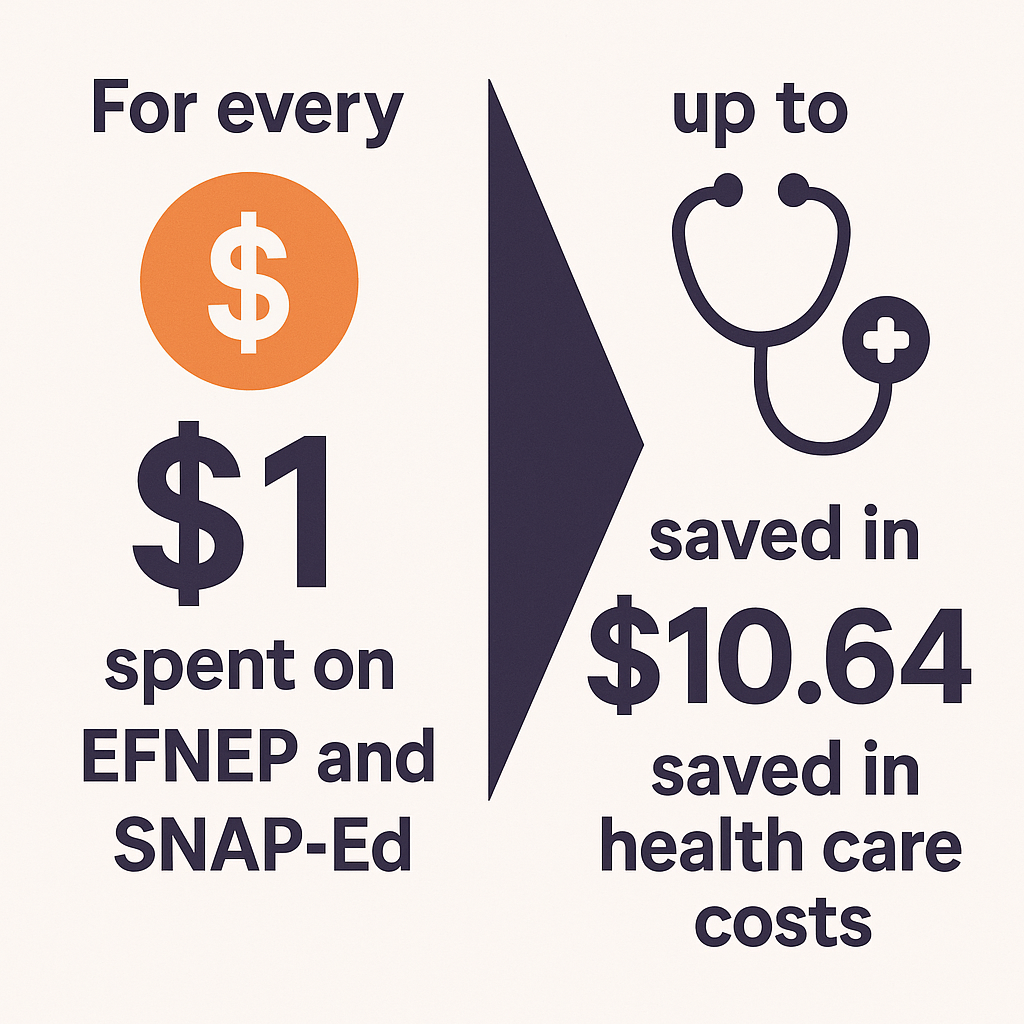
“Existing studies show that for every $1 spent to implement programs such as EFNEP and SNAP-Ed education programs, up to $10.64 is saved in health care costs.5 These studies pre-date the provisions of HHFKA and SNAP-Ed's expanded reach through comprehensive scope of services, thus we anticipate potential health care costs savings to be even greater.”
SNAP-Ed (Supplemental Nutrition Assistance Program-Education) Increases Long-Term Food Security among Indiana Households with Children in a Randomized Controlled Study

Rivera, R. L., Maulding, M. K., Abbott, A. R., Craig, B. A., & Eicher-Miller, H. A. (2016). SNAP-Ed (Supplemental Nutrition Assistance Program-Education) Increases Long-Term Food Security among Indiana Households with Children in a Randomized Controlled Study. The Journal of nutrition, 146(11), 2375–2382. https://doi.org/10.3945/jn.116.231373
The SNAP-Ed Evaluation Framework: demonstrating the impact of a national framework for obesity prevention in low-income populations

This article introduces and describes the benefits of the newly developed SNAP-Ed Evaluation Framework (Framework) and companion Interpretive Guide to consistently measure SNAP-Ed outcomes across different settings
Effect of Supplemental Nutrition Assistance Program–Education (SNAP-Ed) on food security and dietary outcomes

This narrative review summarizes current investigations of SNAP-Ed’s effectiveness at improving food security and dietary outcomes, and it can help inform future policy and implementation of the program.
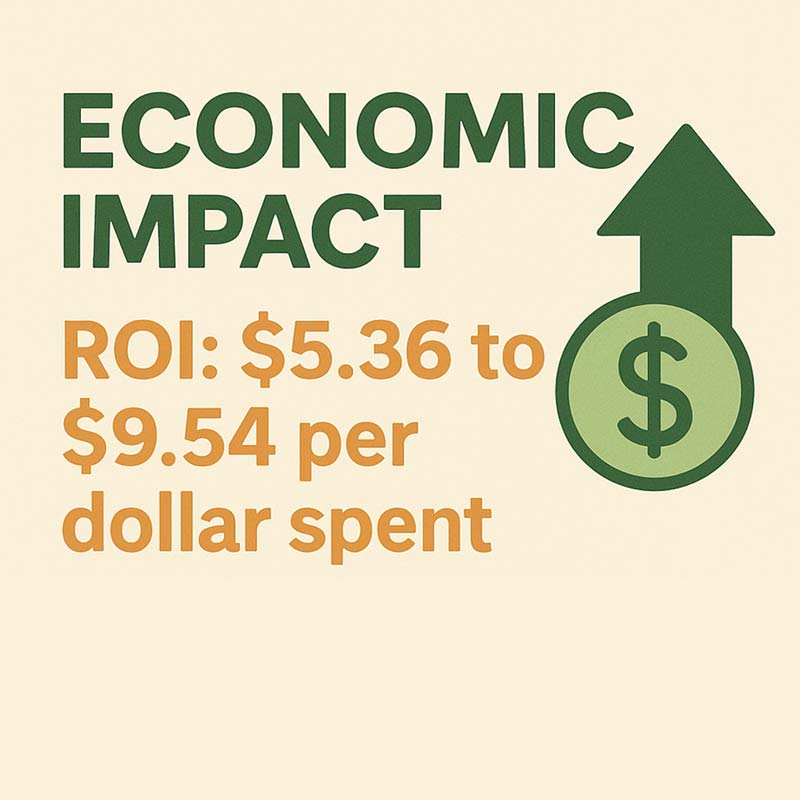
Cost-benefit analysis conducted for nutrition education in California:

A cost-benefit analysis was conducted using the program demographics and food-related dietary behavior of participants enrolled in California’s Expanded Food and Nutrition Education Program (EFNEP), based on methodology developed by Virginia Cooperative Extension.
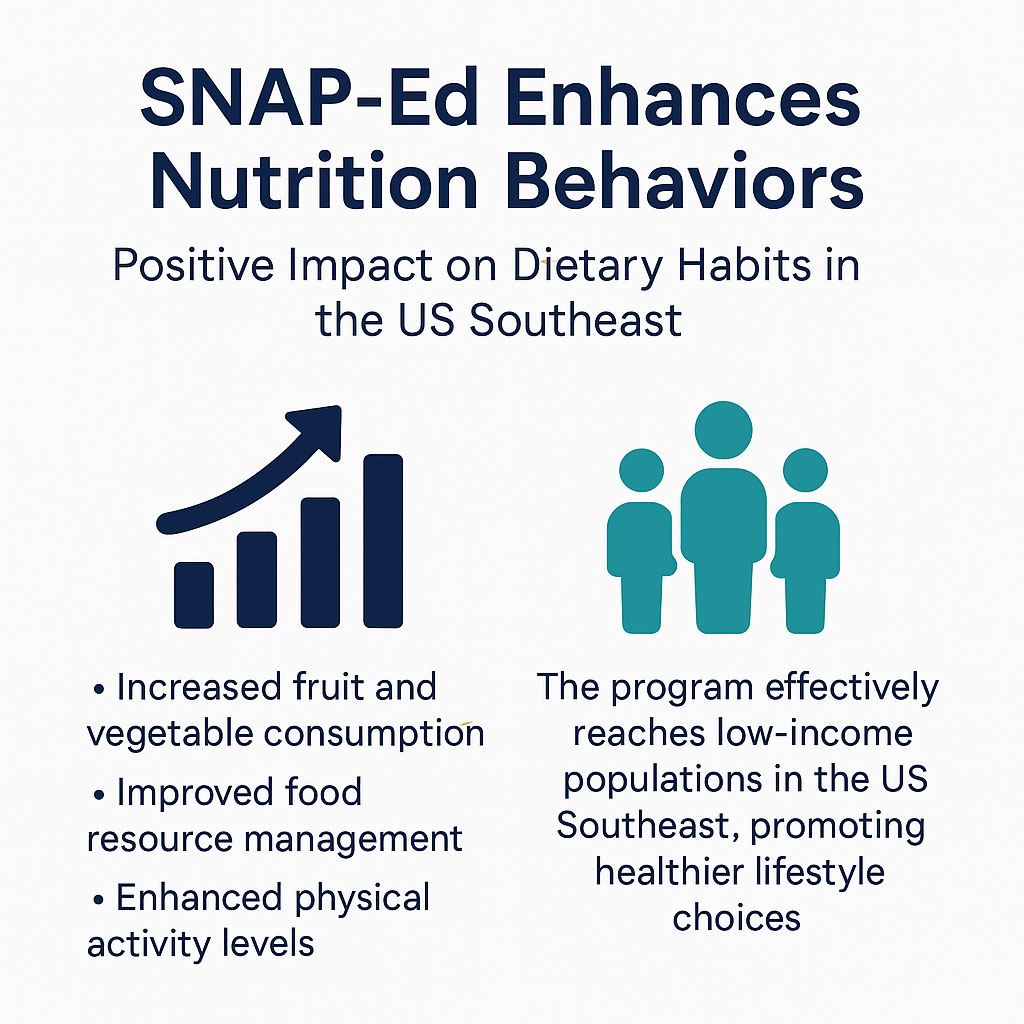
The US Supplemental Nutrition Assistance Program – Education improves nutrition-related behaviors

This study suggests that SNAP-Ed direct education is associated with positive behaviour changes in the US Southeast.
Supplemental Nutrition Assistance Program Education reductions during COVID-19 may have exacerbated health inequities

Woodward-Lopez, G., Esaryk, E. E., Hewawitharana, S. C., Kao, J., Talmage, E., & Rider, C. D. (2023).

Making Headlines

“[SNAP] is really MAHA for low-income people,” Jerry Mande, adjunct professor of nutrition at Harvard T.H. Chan School of Public Health, told your host. “Not just SNAP recipients, but all low-income people.”
The Supplemental Nutrition Assistance Program Education, or SNAP-Ed, faces elimination in a GOP bill, sparking concerns about the impact on low-income Americans' health education.
"The cost of this program is roughly half a billion dollars a year, not even a rounding error in the federal budget. Cutting it does no good for anyone, undercuts the MAHA (Make America Healthy Again) agenda, and is thoughtless and unnecessary."
“It does, in fact, enact deep cuts to Medicaid and SNAP that will result in eligible people losing those benefits. It will raise grocery prices and health care costs for tens of thousands of West Virginia families,”
“The loss of SNAP-Ed funding may further hinder public health efforts, reducing resources for obesity prevention and nutrition education in immigrant communities. States may face pressure to cover these gaps, but fiscal constraints could limit such efforts, disproportionately harming low-income and immigrant populations.”
An initial analysis by the Wisconsin DHS showed that a set of proposals in the new bill to cut funding for the SNAP program would take food away from families, shift costs to Wisconsin taxpayers, and increase red-tape requirements, making it harder for parents, kids, people with disabilities, and older adults to get food assistance.

Take Action Today!​